A drug is a substance used for a medical purpose either alone or in mixture. It becomes poisonous when taken in over doses drugs affect not only the body but the brain too. Morphia, a drug obtained from opium cases sleep. The diseases of the mind are more dangerous than that those of the body. The men of the medicine extract drugs from some parts of the plants which contain the elements of the drug. The drug extracted from the roots of rauwolfia and cinchona causes high blood pressure.
Sometimes must be done to save our youths from going astray because youth of today are the leaders of tomorrow. This great and stupendous task cannot be performed by diseased minds. So every possible remedy must be put into immediate action before drug addiction becomes wide spread and out of control. The authorities concerned must stop the smuggling of each and every citizen to sweep our nation clean of garbage produced by drugs. Mny parents have been applying various preventive measures to free their sons and daughters from drug addiction. They are successful only to some extent. If we want our nation to march ahead we must do our best to stop drug addiction by every possible ways and means. The problem of drug addiction must be tackled before this deadly menace gets upon the whole nation.
Thursday, December 24, 2009

Deforestation
Deforestation means cutting down trees either to make space for people or for wood. With the rapid growth of population the space available now has become too small. People have therefore started cutting down trees to make room for their homes and for cultivating food. People are so unaware so that they cut down trees very frequently. People of the village are very ignorant. They don’t understand the importance of green trees. People cut down trees to make rooms or to gather fire wood or for wood for furniture. There are many people who depend upon jungle for their daily needs. They cut down trees and sell the wood for their living. Lack of education, poverty and over population are three main factors to cause deforestation.
Due to lack of education, the people have not understood the importance of green forests. Forests are the home of many wild insect, birds and animals. Due to deforestation, they are directly affected. All the animals which live in jungles are part of the biological eco-system. It is very necessary to understand that every of these animals are part of the eco system.
Besides forests helps to restore the balance of nature. It purifies the air. It stops the flood. Landslide and dissertation. By cutting down trees we are not only destroying ourselves. Before it gates late we all must understand the importance of forests and take all possible steps to stop deforestation. We all must be encourage to plant trees and preserve our precious forests. By preserving forest we are preserving ourselves.
Agriculture in Nepal
Nepal is a country of villages. It is also a land-locked country. Nepal has very less factories. The main occupation of the people is Agriculture. About 90% of the total population depends upon Agriculture can be minimized. Although Nepal is a small kingdom, the climate varies her from tropical hot climate of terai to freezing cold of Himalayas Different types of crops are grown in different variation of the climates. In the plain the land is fertile. The rainfall and other weather conditions are also suitable to grow crops. The main crops grown in the plain are rice, wheat, sugarcane, maize and pulses. Wheat is a winter crop. Jute is another important crop in the plains.
There are many factors which have affected our agriculture and the farmers. The most of the farmers are uneducated and therefore they don’t change their primitive method of farming. They don’t use scientific method of farming. Besides, the government is not able to train these farmers for scientific and intensive ways of farming. Although, Nepal is rich in water resources and many places have to depend on monsoon for irrigation. The irrigation facility is still not very wide. Chemical fertilizers are scarce and very costly. People can not afford to buy these chemical fertilizers. There is no good market for their products. Due to the problem of transportation they have to sell their agricultural products in cheap prices. If we are able to train farmers give them good irrigation facility and market and all necessary things we will certainly raise our agriculture.
There are many factors which have affected our agriculture and the farmers. The most of the farmers are uneducated and therefore they don’t change their primitive method of farming. They don’t use scientific method of farming. Besides, the government is not able to train these farmers for scientific and intensive ways of farming. Although, Nepal is rich in water resources and many places have to depend on monsoon for irrigation. The irrigation facility is still not very wide. Chemical fertilizers are scarce and very costly. People can not afford to buy these chemical fertilizers. There is no good market for their products. Due to the problem of transportation they have to sell their agricultural products in cheap prices. If we are able to train farmers give them good irrigation facility and market and all necessary things we will certainly raise our agriculture.
Tuesday, December 15, 2009
People of Nepal
Nepal, officially Federal Democratic Republic of Nepal, is the world's youngest republic. Earlier, Nepal was a constitutional monarchy and it became a democratic republic on May 28, 2008. Locked within the rugged ranges of the Himalayas, Nepal is bounded by the Tibet region of China on the North and India on the South, East, and West. The Kingdom of Bhutan lies in its East whereas the Autonomous region of Tibet in Northeast. There are various entry points from the Indian side but the major ones are Nepal Gunj, Mahendra Nagar and Bir Gunj. From the Chinese side there are couple of passes to enter Nepal. Some of the major ones are Renjo La at 5465 meters, Cho La at 5420 meters and Kongma La at 5535 meters. There is only one entry to Tibet and Bhutan and that is Lungu La pass.
It was cut off from the rest of the world until the early 1950s. A palace revolution and the subsequent overthrow of the autocratic Rana dynasty marked the beginning of Nepal's emergence into the modern world. Kathmandu is the capital and the largest city.
It was cut off from the rest of the world until the early 1950s. A palace revolution and the subsequent overthrow of the autocratic Rana dynasty marked the beginning of Nepal's emergence into the modern world. Kathmandu is the capital and the largest city.
Saturday, December 12, 2009
Bartabanda
The ceremony begins with, you guessed it, the boys having their heads shaved except for a tiny tail on top that is tied with rings and sometimes jewels . The boys at the Kumbeshwor Temple were all wrapped in bright orange or yellow garb for rituals that last up to five hours. A priest instructs the boys in the lessons of manhood and gives each his own mantra shrouded in secret . There is much burning of incense, tossing of rice, dousing with vermilion powder and making of offerings.Each boy has a staff, a stick slung with bags of grain to feed him on his journey into manhood, a toy-like bow to protect himself from wild animals and a skin, preferably a deer skin, to sleep on as he journeys through the forest.
The boys take a symbolic journey, walking with their possessions around the ritual offerings laid out in front of them . The beautifully dressed women of the family make offerings of food to the boys to sustain them on their journey. At the end, a cotton string is looped over the boy's shoulder, signifying that he is now a man, even if he is only five
The boys take a symbolic journey, walking with their possessions around the ritual offerings laid out in front of them . The beautifully dressed women of the family make offerings of food to the boys to sustain them on their journey. At the end, a cotton string is looped over the boy's shoulder, signifying that he is now a man, even if he is only five
Thursday, December 10, 2009
Religion in Nepal
Nepal was formerly the world's only constitutionally declared Hindu state, but following the movement for democracy in earlyParliament amended the constitution to make Nepal a secular state.
According to the 2001 census, 80.6 percent of Nepalese are 2006 and the breaking of King Gyanendra's power, the Nepali Hindu, 10.7 percent are Buddhist, 10% are Muslim[1], 3.6 percent are Kirat (an indigenous religion with Hindu influence), 0.5 percent are Christian, and 0.4 percent are classified as other groups such as Bön religion. Although the population is mostly Hindu, since the 1971 census Hindus have shown the greatest decline as a proportion of the population, and Buddhists and Kirats have increased the most: in 1971 Hindus were 89.4 percent of the population, Buddhists 7.5 percent, and Kirats statistically 0 percent. However, statistics on religious groups are complicated by the ubiquity of dual faith practices, particularly among Hindus and Buddhists. Moreover, shifts in the population's religious composition also reflect political changes.
According to the 2001 census, 80.6 percent of Nepalese are 2006 and the breaking of King Gyanendra's power, the Nepali Hindu, 10.7 percent are Buddhist, 10% are Muslim[1], 3.6 percent are Kirat (an indigenous religion with Hindu influence), 0.5 percent are Christian, and 0.4 percent are classified as other groups such as Bön religion. Although the population is mostly Hindu, since the 1971 census Hindus have shown the greatest decline as a proportion of the population, and Buddhists and Kirats have increased the most: in 1971 Hindus were 89.4 percent of the population, Buddhists 7.5 percent, and Kirats statistically 0 percent. However, statistics on religious groups are complicated by the ubiquity of dual faith practices, particularly among Hindus and Buddhists. Moreover, shifts in the population's religious composition also reflect political changes.
Sunday, November 29, 2009
Visit Nepal
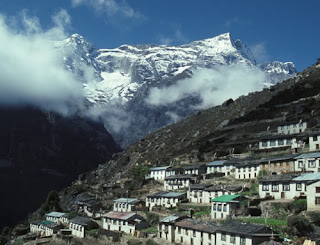 It was only in the year 1980’s that Nepal came out of its centuries old loneliness and moved into the path of modern development. After Nepal has been opened for the world it has affected many fields. It has improved our economy through different aspects, Moreover; tourists coming from different places go back and make our nation known to many other people. Now, after 47 years, the government of our country ha decided to celebrate visit Nepal year 1998. The number of tourists was 6000 in 1962, and now it has increased to 377 thousands. The government is ready to welcome half a million tourist by 1998.
Tourists mainly come to our country with three purposes: firstly for viewing the natural beauties, secondly to observe the ancient and modern art and architecture, and the third with religious aspects. Though Nepal is small in size and poor in economy, it gives different unforgettable experiences and feelings to the people. Enchanting monuments and festivals of the Katmandu valley, snow peaks, the Himalayas the dense jungle, the birth place if Buddha and other opportunities like rafting, trekking and mountaineering are other important factors. Besides, many Hindus visit Nepal with religious aspects also.
It is very beneficial for our economy to increase the number of incoming tourists. Besides, it helps us to improve and open a lot of other areas such as hotels, transportation, and communication, shopping facilities, which also means progress. They leave their foreign currencies on our land. Furthermore, we can make our country known to the world through these tourists. Tourists are our guests. It becomes our responsibility to welcome them with our open arms. We all must therefore make visit Nepal year successful.
Subscribe to:
Posts (Atom)


